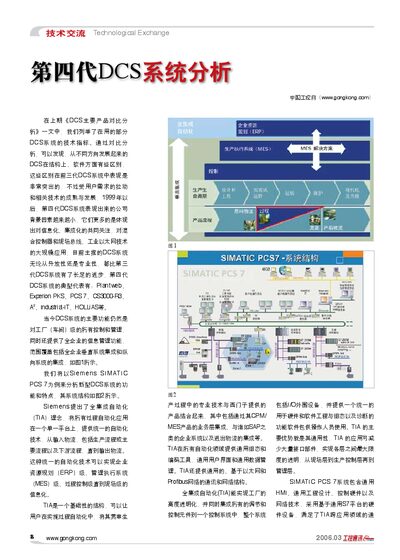
An overview of fourth‑generation DCS systems using Siemens SIMATIC PCS 7 as a case study.
About this manual
The article reviews the evolution of distributed control systems (DCS) and explains how fourth‑generation DCS platforms, such as Siemens' SIMATIC PCS 7, integrate information technology, industrial Ethernet, and large‑scale field‑bus applications. It highlights the shift from proprietary, generation‑specific designs to open, highly integrated solutions that support enterprise‑wide data management and vertical/horizontal integration.
SIMATIC PCS 7 is described in detail, covering its TIA (Totally Integrated Automation) concept, hardware platform (400 series controllers, ET200 I/O families), communication stacks (Profibus, Profibus PA, PROFINET, HART, Ethernet), scalability up to 100 000 I/O points, redundancy at controller and network levels, and integration with IT systems via OPC, SAP, and the SIMATIC IT Framework. The document also outlines batch‑process automation, system openness, and performance specifications. This manual is written in Chinese.
What's inside
- Fourth‑Generation DCS Overview
- SIMATIC PCS 7 Architecture
- Horizontal Integration
- Vertical Integration
- Hardware and Control Platform
- Field System Integration
- Scalability and Redundancy
- IT Environment Interface
- Batch Process Automation
- System Openness
Specifications
| Supported IEC 61131 standard | Yes |
|---|
| Maximum PID loops per CPU | 300‑500 |
|---|
| Maximum external I/O per CPU | 3000 |
|---|
| Control algorithm software names | INCA, RaPID, ADCO |
|---|
| Redundancy support | Full redundancy for controllers, I/O, and database |
|---|
Frequently asked questions
How many external I/O points can a PCS 7 controller handle?
A PCS 7 controller can handle up to 3 000 external I/O points per CPU.
Does SIMATIC PCS 7 provide system redundancy?
Yes, PCS 7 offers full redundancy for controllers, I/O modules, and the real‑time/history database.