
Key facts
- Brand
- Chaperone
- Model
- BL21
- Documents
- 2
- Languages
- ZH
- Last added
- 2012-03-14
Start here
Takara Chaperone Competent Cells BL21 User Manual
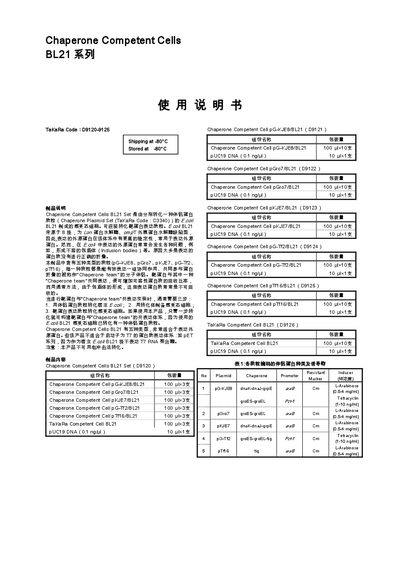
This manual describes the Chaperone Competent Cells BL21 product, which consists of Eco BL21 cells transformed with a chaperone plasmid set. The cells are shipped and stored at -80 °C and are supplied in multiple 100 µL vials containing different chaperone plasmids.
The document details the recommended thawing, mixing, DNA addition (≤10 ng), heat‑shock steps, recovery in SOC medium, and plating procedures. It also notes incompatibility with T7‑based expression vectors, the prohibition of electroporation, and storage guidelines to maintain high transformation efficiency. This manual is written in Chinese.
Chaperone BL21 specifications
| Shipping temperature | -80 °C |
|---|---|
| Storage temperature | -80 °C |
| Cell strain | Eco BL21, protease‑deficient |
| Plasmid packaging | 100 µL ×3 vials per plasmid type |
| T7 promoter compatibility | Not compatible |
| Electroporation use | Not allowed |
| Maximum DNA per transformation | ≤10 ng |
| Typical transformation efficiency | >10⁷ cfu/µg DNA |
All Chaperone BL21 documents by type
Day-to-day operation, settings and troubleshooting. Start here if the product is already set up.
Questions answered in these manuals
What temperature should the Chaperone Competent Cells BL21 be stored at?
They should be stored at -80 °C.
Can the BL21 cells be used with T7‑promoter expression vectors?
No, the cells do not express T7 RNA polymerase and are not compatible with T7‑based vectors such as the PET series.
How should the competent cells be stored?
Store the cells at –80 °C; if not kept at this temperature the transformation efficiency will drop.
What is the maximum amount of DNA to use for a transformation?
Use no more than 10 ng of DNA per reaction to maintain high transformation efficiency.