
This kit is used for the quantitative determination of PLGF in rat serum, plasma, cell culture supernatant or other related biological fluids
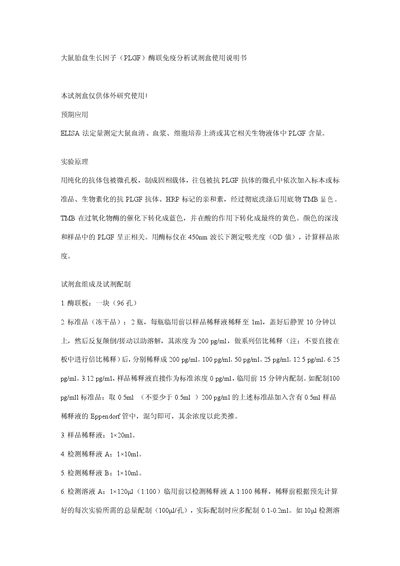
This manual describes the ELISA method for quantitatively measuring rat placental growth factor (PLGF) in various biological fluids. It explains the principle of using a coated micro‑plate with capture antibody, biotinylated detection antibody, and HRP‑streptavidin, followed by a TMB substrate reaction measured at 450 nm.
The kit includes a 96‑well plate, standards, sample diluent, detection reagents, substrate, wash buffer, and stop solution. Detailed steps cover sample preparation, reagent handling, incubation times (typically 37 °C for 60–120 min), washing procedures, color development, and data analysis using a standard curve. This manual is written in Chinese.
| Detection range | 3.12 – 200 pg/mL |
|---|---|
| Lower limit of detection | 1 pg/mL |
| Incubation temperature | 37 °C |
| Reading wavelength | 450 nm |
| Reagent storage temperature | -20 °C for some reagents; 2‑8 °C for others |
The kit can detect PLGF concentrations from 3.12 pg/mL up to 200 pg/mL.
Absorbance should be read at 450 nm.
Collect whole blood, let it sit at room temperature for 2 h or 4 °C overnight, centrifuge at 1000 × g for 20 min, take the supernatant, and store at –20 °C or –80 °C, avoiding repeated freeze‑thaw cycles.
All incubation steps are performed at 37 °C.