
Key facts
- Manuals
- 3
- Models
- 1
- Categories
- 1
- Languages
- ZH · JA
- Last added
- 2012-01-11
RING models by category
Featured RING manuals
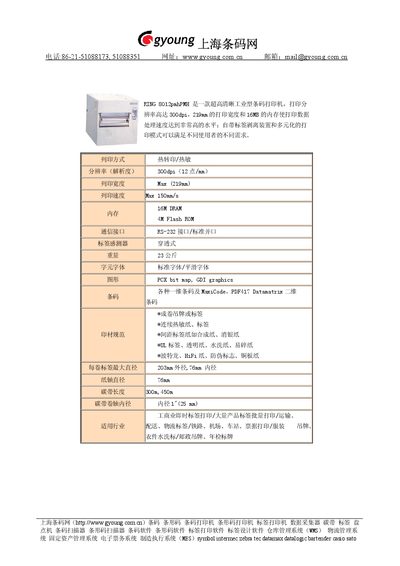
RING 8012pmhPMH Barcode Printer Manual
The RING 8012pmhPMH is an ultra‑high‑definition industrial barcode printer with a 219 mm print width, 300 dpi resolution and up to 150 mm/s printing speed. It includes 16 MB of memory, a built‑in label peel‑off device and supports both thermal transfer and direct thermal printing.
The printer offers RS‑232 and standard parallel communication interfaces, a through‑type label sensor, and can handle a variety of media such as continuous thermal paper, label rolls, UL‑rated labels, transparent and water‑washable papers. It supports 1‑D barcodes, MaxiCode, PDF417, DataMatrix and other 2‑D codes, making it suitable for logistics, retail, manufacturing and transportation applications. This manual is written in Chinese.
Covers: Printing Method · Resolution · Print Width · Print Speed · Communication Interface · Label Sensor
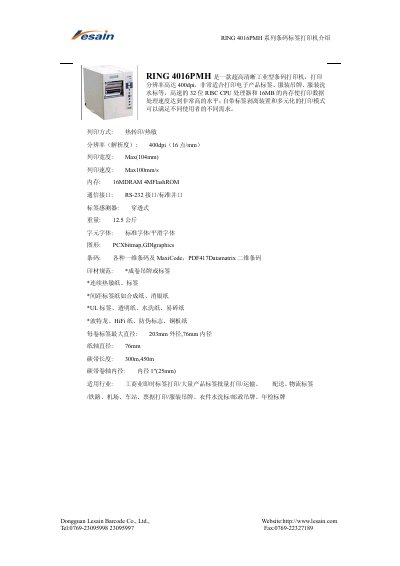
RING 4016PMH Barcode Label Printer Product Leaflet
The RING 4016PMH is a high‑definition industrial barcode label printer designed for electronic product tags, apparel hang tags, wash labels and other applications. It features a fast 32‑bit RISC CPU, 16 MB of memory, and a built‑in label peel‑off device with multiple printing modes to meet diverse user needs.
Key specifications include 400 dpi resolution, a maximum print width of 104 mm, print speed up to 100 mm/s, RS‑232 and parallel communication interfaces, and support for a wide range of media such as roll labels, continuous thermal paper, synthetic and security‑grade papers. The printer weighs 12.5 kg and offers ribbon lengths of 300 m or 450 m. This manual is written in Chinese.
Covers: Printing Method · Resolution · Print Width · Print Speed · Memory · CPU
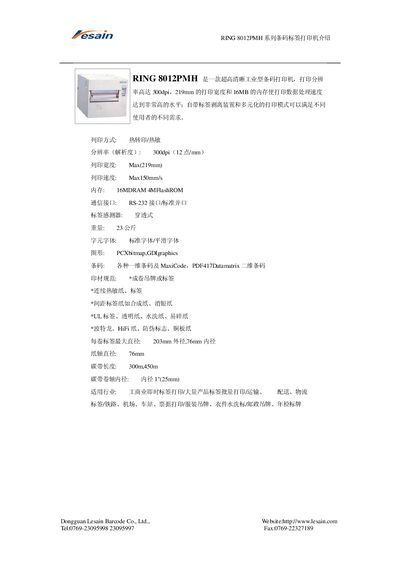
RING 8012PMH Barcode Label Printer User Manual
The RING 8012PMH is a high‑resolution barcode label printer offering a 300 dpi (12 dots/mm) printing resolution and a maximum print width of 219 mm. It supports a variety of barcode formats such as MaxiCode and PDF417, and can print on different label materials including metal, plastic, and washable fabrics.
The printer includes 16 MB DRAM and 4 MB Flash ROM for data storage, and communicates via an RS‑232 interface. It features a built‑in sensor for label detection and offers multiple font options. The device weighs approximately 23 kg and is suitable for applications in logistics, retail, and manufacturing. This manual is written in Japanese.
Covers: Printing Method · Resolution · Print Width · Print Speed · Memory · Communication Interface
Latest RING manuals
RING 8012pmhPMH Barcode Printer Manual
Product Leaflet 1 pages · 110 KB · ZHThe RING 8012pmhPMH industrial barcode printer manual provides specifications, printing modes, and interface details.
RING 4016PMH Barcode Label Printer Product Leaflet
Product Leaflet 1 pages · 65 KB · ZHThe RING 4016PMH barcode label printer is an industrial high‑resolution printer with 400 dpi, a 32‑bit RISC CPU, and supports both thermal transfer and…
RING 8012PMH Barcode Label Printer User Manual
User Manual 1 pages · 63 KB · JAThe RING 8012PMH barcode label printer manual provides specifications, printing modes, and interface details for users.
Which document do I need?
User Manual
Day-to-day operation, settings and troubleshooting. Start here if the product is already set up.
Questions answered in RING manuals
What printing methods does the RING 8012pmhPMH support?
It supports both thermal transfer and direct thermal printing.
What is the maximum print resolution of the printer?
The printer can print at up to 300 dpi (12 dots per millimeter).
What printing methods does the RING 4016PMH support?
It supports both thermal transfer and direct thermal printing.
What is the maximum print resolution of the printer?
The printer can print at a resolution of 400 dpi (16 dots per mm).
What is the printing resolution of the RING 8012PMH?
The printer provides a resolution of 300 dpi (12 dots per mm).
Which communication interface does the printer use?
It uses an RS‑232 interface for data communication.