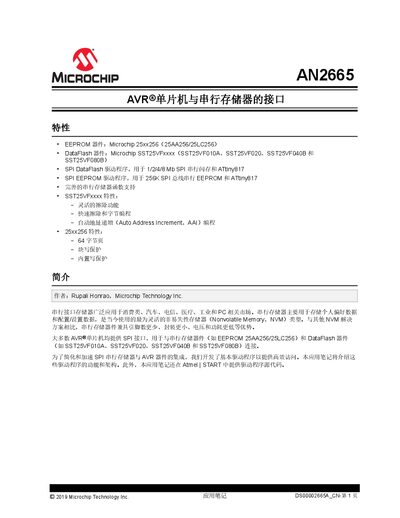
Application note describing how to connect AVR® microcontrollers to Microchip 25xx256 EEPROM and SST25VFxxxx DataFlash devices.
About this manual
This application note explains the hardware connection, SPI access methods, and driver functions for interfacing AVR® microcontrollers with Microchip serial memory devices such as the 25xx256 EEPROM and SST25VFxxxx DataFlash. It includes details on voltage ranges, write protection, and busy‑status detection.
The document also provides source‑code examples that can be downloaded from Atmel | START, and describes how to use polling or interrupt‑based SPI peripheral handling. Version history and support information are listed at the end. This manual is written in Chinese.
What's inside
- Introduction
- Serial Memory Devices
- Hardware Connection
- SPI Serial Memory Access Methods
- SPI Peripheral Handling
- Busy Detection
- Getting Source Code from Atmel | START
- Source Code Overview
- Development Environment
- Version History
Specifications
| EEPROM device | 25xx256 (25AA256/25LC256) |
|---|
| DataFlash device | SST25VFxxxx (SST25VF010A, SST25VF020, SST25VF040B, SST25VF080B) |
|---|
| EEPROM voltage range | 1.8 V to 5.5 V |
|---|
| DataFlash voltage range | 2.7 V to 3.6 V |
|---|
Frequently asked questions
What command enables write operations on the serial memory devices?
The WREN command is used to enable write operations before any write or erase command.
How is the busy status indicated for SST25VFxxxx devices?
Busy status is indicated by the BUSY bit in the device’s status register; a value of 1 means the device is busy.
Which SPI modes are supported by the serial memory devices?
Both SPI mode 0 (CPOL=0, CPHA=0) and SPI mode 3 (CPOL=1, CPHA=1) are supported.