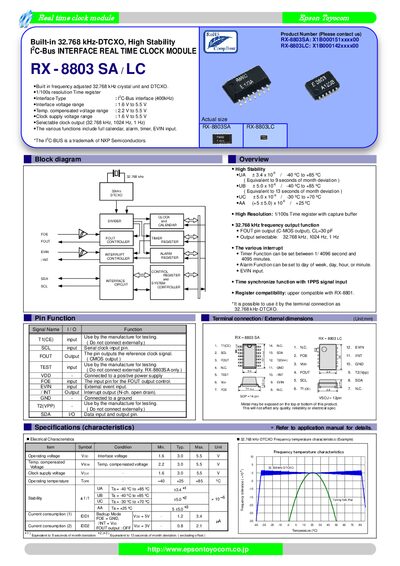
The Epson RX-8803SA and RX-8803LC RTC modules provide high stability, 1/100 s resolution, I²C interface and selectable clock outputs.
About this manual
The Epson RX-8803SA and RX-8803LC are real‑time clock modules that combine a built‑in 32.768 kHz DTCXO with high stability and a 1/100 second time register. They support full calendar functions, alarm, timer, external event input (EVIN) and interrupt output.
Communication is via a 400 kHz I²C‑Bus (1.6 V‑5.5 V) and the modules offer selectable clock outputs of 32.768 kHz, 1024 Hz or 1 Hz. The datasheet details pin assignments, electrical characteristics, operating temperature range and low current consumption for both normal and backup modes.
What's inside
- Overview
- Features
- Pin Assignment
- Electrical Characteristics
- Operating Temperature
- Current Consumption
- Frequency Output Options
- Register Compatibility
- Package Dimensions
- Environmental Information
Specifications
| Stability (UA) | ±3.4×10⁻⁶ (-40 °C to +85 °C) |
|---|
| Stability (UB) | ±5.0×10⁻⁶ (-40 °C to +85 °C) |
|---|
| Stability (UC) | ±5.0×10⁻⁶ (-30 °C to +70 °C) |
|---|
| Time resolution | 1/100 second |
|---|
| Interface type | I2C‑Bus (400 kHz) |
|---|
| Selectable clock output frequencies | 32.768 kHz, 1024 Hz, 1 Hz |
|---|
| Operating temperature range | -40 °C to +85 °C |
|---|
| Current consumption (normal mode, VDD=5 V) | 1.2 µA |
|---|
Frequently asked questions
What communication interface does the RX-8803 module use?
It uses an I²C‑Bus interface operating at 400 kHz.
Which clock output frequencies can be selected on the module?
The module can output 32.768 kHz, 1024 Hz, or 1 Hz.
What is the operating temperature range of the RX-8803 modules?
They operate from –40 °C to +85 °C.
What is the time resolution of the RTC registers?
The time register provides a resolution of 1/100 second.