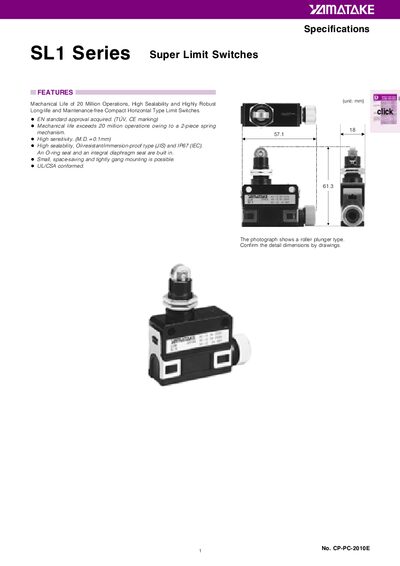
The Yamatake CP-PC-2010ESL1 Series Super Limit Switches specification sheet details mechanical life, sealability, electrical ratings, and environmental limits.
About this manual
The CP-PC-2010ESL1 Series Super Limit Switches are compact horizontal‑type limit switches with a mechanical life of up to 20 million operations and IP67 sealability. They are available in several actuator shapes (roller plunger, lever, cross roller) and can be ordered with options such as high‑temperature, high‑oil resistance, and low‑current load types.
The document lists external standards (UL, CSA, EN, IEC), electrical performance data, mechanical ratings, auxiliary parts, wiring diagrams, and precautions for installation and use. It also defines the environmental operating ranges and restrictions for safety‑critical applications.
What's inside
- Features
- Order Guide
- Options
- Performance
- Electrical rating
- Auxiliary Parts
- Electrical life characteristics
- Appearance, Operating Characteristics and External Dimensions
- Precautions upon Use
- Restrictions on Use
Specifications
| Mechanical life | 20 million operations |
|---|
| Sealability | IP67 (IEC) |
|---|
| Contact type | Single‑Pole Double‑Throw (SPDT) |
|---|
| Operating temperature (standard) | ~10 °C to +70 °C |
|---|
| Operating temperature (high oil/heat) | 0 °C to 120 °C |
|---|
| Impulse dielectric strength | 2,500 V |
|---|
| Operating force (max) | 11.8 N |
|---|
Frequently asked questions
What is the mechanical life of the CP‑PC‑2010ESL1 Series switches?
The switches have a mechanical life that exceeds 20 million operations.
What sealing rating do these limit switches provide?
They are rated IP67 (IEC) for high sealability and immersion‑proof performance.
What are the allowed operating temperature ranges?
The standard type operates from about 10 °C to +70 °C, while the high‑oil and heat‑resistant type can be used from 0 °C to 120 °C.
How should lead wire tips be prepared to avoid short‑circuit failure?
Profile the lead‑wire tip and use a round crimp‑type terminal lug with an M3 insulation sleeve; avoid bare crimp‑type lugs.