
Key facts
- Manuals
- 3
- Languages
- EN
- Last added
- 2012-02-16
Featured Flowell manuals

Flowell F-LOCK 30 SERIES Tube Fittings Installation Guide
The F‑LOCK 30 SERIES tube fittings use a Taper‑Swaging seal that provides a tight, leak‑free connection by simply inserting the tube and tightening a nut. The compact, two‑piece design is made from fluorocarbon resin (PTFE) for the body and ECTFE for the nut, offering excellent chemical resistance for use in corrosive fluids, semiconductor equipment and laboratory applications.
Installation involves inserting the tube, hand‑tightening the nut, and then using a wrench to reach the specified torque. The manual lists maximum working temperature (100 °C for ECTFE nut, 80 °C for 19 mm O.D.), material details, applicable tube types (PFA, PTFE) and reference torque values to ensure reliable performance.
Covers: Sealing System · Materials · Maximum Working Temperature · Applicable Tubes · Installation Procedure · Torque Values

Flowell 60 Series Tube Fittings User Manual
The 60 Series tube fittings are flare‑type fluorocarbon resin components designed for semiconductor manufacturing. They feature a unique body and nut construction that minimizes fluid trapping, leakage and the need for re‑tightening.
The manual covers construction details, part numbers, pressure‑temperature ratings, ordering procedures, installation methods (cold and hot flaring) and safety guidelines for maintenance in harsh chemical and high‑pressure environments.
Covers: Introduction · Construction · Specifications · Configurations · Ordering Information · Pressure‑Temperature Ratings
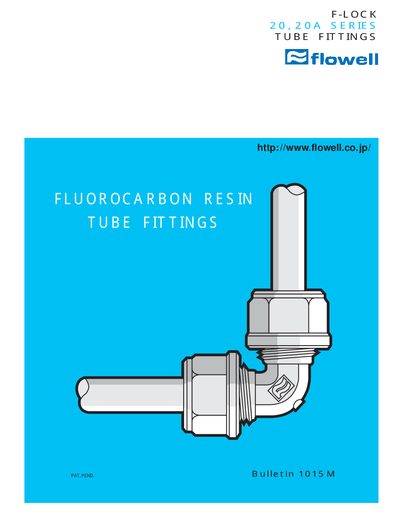
Flowell 20/20A Series Tube Fittings Manual
The Flowell 20/20A Series tube fittings are made of fluorocarbon resin and feature a unique internal‑ring construction that ensures excellent sealing, chemical resistance and high‑temperature capability. The fittings are compatible with NPT threads ranging from 1/8" to 1" and are interchangeable with the 20 Series body and nut, while using a slightly different ring.
The manual includes product features, ordering information, dimensional tables, installation instructions, and detailed maintenance cautions. It explains the use of a Go/No‑Go gauge and a life spacer to monitor the remaining service life of the fittings and provides safety procedures for disassembly and leak checks.
Covers: Introduction · Features · How To Order · Notation · Specifications · Configurations
Latest Flowell manuals
Flowell F-LOCK 30 SERIES Tube Fittings Installation Guide
Installation Guide 20 pages · 282 KB · ENInstallation guide for Flowell F-LOCK 30 SERIES tube fittings, covering the Taper‑Swaging seal, assembly steps, material specs and tightening torque.
Flowell 60 Series Tube Fittings User Manual
User Manual 40 pages · 467 KB · ENThe Flowell 60 Series tube fittings manual provides specifications, ordering info, assembly steps and maintenance cautions.
Flowell 20/20A Series Tube Fittings Manual
Service Manual 28 pages · 1.6 MB · ENThe Flowell 20/20A Series tube fittings manual provides features, specifications, ordering details, installation steps and maintenance guidance.
Which document do I need?
Installation Guide
Mounting, wiring and first power-up. Read it before the hardware goes in.
User Manual
Day-to-day operation, settings and troubleshooting. Start here if the product is already set up.
Service Manual
Disassembly, diagnostics and part numbers, for repair.
Questions answered in Flowell manuals
How do I install the tube fitting?
Insert the tube into the body of the fitting, tighten the nut by hand, then finish tightening with a wrench to the specified number of turns.
From: Flowell F-LOCK 30 SERIES Tube Fittings Installation Guide
What torque should be used for tightening the nut?
Use the reference torque values provided; do not exceed 1.5 times the reference torque to avoid damaging the threads.
From: Flowell F-LOCK 30 SERIES Tube Fittings Installation Guide
What sealing mechanism does the 60 Series tube fitting use?
It uses a flare‑type sealing mechanism.
How can I order the 60 Series tube fittings?
Orders must specify the part number for each fitting.
How can I check the remaining life of a tube fitting?
Use the Go/No‑Go gauge and the Life spacer; they indicate the remaining service life of the fitting.
What should I do if a tube fitting leaks?
Tighten the nut an additional 1/8 to 1/4 turn; if leakage persists, replace the fitting.