
Key facts
- Manuals
- 1
- Languages
- ZH
- Last added
- 2026-10-03
Featured 重庆博蓝鹰生物技术有限公司 manuals
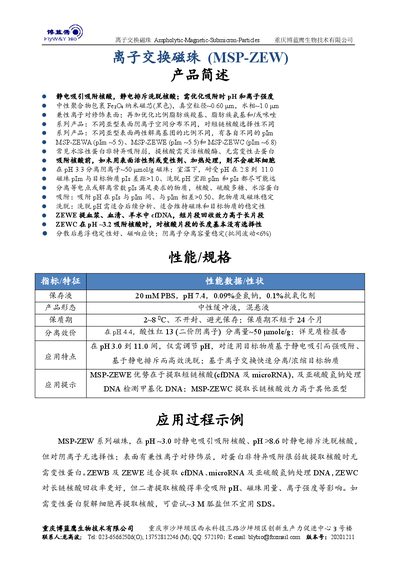
Chongqing Boliangying Ampholytic-Magnetic-Submicron-Particles Ion Exchange Magnetic Beads Product Data Sheet
The Ampholytic‑Magnetic‑Submicron‑Particles (MSP‑ZEW series) are sub‑micron magnetic beads (≈0.60 µm in vacuum, ≈1.0 µm in water) coated with a neutral polymer that encapsulates an Fe₃O₄ core. Their surface carries both positive and negative ionizable groups, allowing electrostatic attraction of nucleic acids at acidic pH and electrostatic repulsion for elution at basic pH. The beads are supplied as a neutral‑buffered suspension (20 mM PBS, pH 7.4, 0.09 % azide, 0.1 % antioxidant) and remain stable for at least 24 months when stored unopened, protected from light.
The document provides detailed reagent recipes, step‑by‑step extraction protocols for plasma cfDNA, microRNA and other biomolecules, and performance data such as a separation capacity of ~50 µmol g⁻¹ for Acid Red 13 at pH 4.4. It also includes stability tests, regeneration procedures, and comparative third‑party testing against competing magnetic bead products. This manual is written in Chinese.
Covers: Product Overview · Physical and Chemical Specifications · Reagents and Equipment · Extraction Protocol · Performance Data · Stability and Regeneration
Latest 重庆博蓝鹰生物技术有限公司 manuals
Chongqing Boliangying Ampholytic-Magnetic-Submicron-Particles Ion Exchange Magnetic Beads Product Data Sheet
Product Leaflet 7 pages · 1.2 MB · ZHAmpholytic-Magnetic-Submicron-Particles magnetic beads from Chongqing Boliangying enable pH‑controlled ion‑exchange extraction of nucleic acids, proteins…
Questions answered in 重庆博蓝鹰生物技术有限公司 manuals
What pH range can the beads be used in for adsorption and elution?
The beads adsorb nucleic acids at acidic pH (≈3.0‑3.3) and elute them at basic pH (≈8.6‑8.9), and they remain stable from pH 2.8 to 11.0.
How long can the beads tolerate low‑pH conditions at room temperature?
The MSP‑ZEW series beads tolerate pH ≈2.5 at room temperature for about 2 hours, but they demagnetize at 56 °C under the same pH.