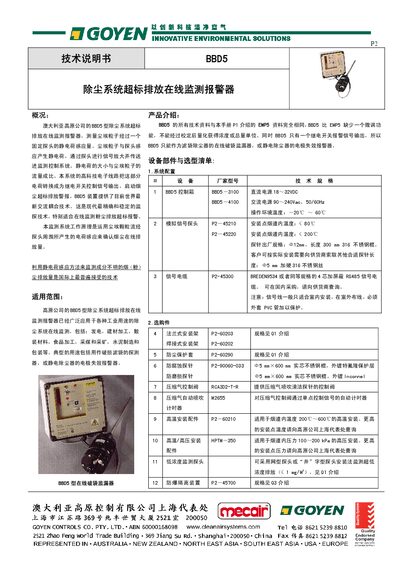
Technical manual for the BBD5 dust monitoring alarm by Gao Yuan, covering operation, installation, specifications and maintenance.
About this manual
The BBD5 dust monitoring alarm from Gao Yuan uses electrostatic charge sensing to detect dust particles passing a fixed probe. The system converts the charge into a relay‑switch control signal that triggers an alarm when dust emissions exceed preset limits. It is designed for online monitoring of dust emissions in various industrial dust‑removal systems such as power plants, cement factories and mining operations.
The manual provides a detailed overview of the device, a full parts and selection list, technical specifications, control‑panel description, instrument settings, probe maintenance procedures and recommended installation practices. This manual is written in Chinese.
What's inside
- 概况
- 适用范围
- 设备部件与选型清单
- 技术规范
- BBD5主控制面板介绍
- 仪器设定
- 探头的保养和维修
- 建议
Specifications
| Operating temperature (electronics) | -20 °C ~ 60 °C |
|---|
| Operating humidity | 0 % – 90 % (non‑condensing) |
|---|
| Protection rating | IP66 / NEMA4 |
|---|
| Power supply | DC 18‑32 V, AC 90‑240 V 50/60 Hz |
|---|
| Signal cable | 4‑core shielded RS485 |
|---|
| Maximum duct pressure | 100 kPa (15 psi) |
|---|
| Measurement accuracy | 0.2 mg/m³ |
|---|
| Maximum cleaning air pressure | 400 kPa (60 psi) |
|---|
Frequently asked questions
What type of output signal does the BBD5 provide?
The BBD5 provides only a relay‑switch alarm signal; it does not output a continuous analog signal.
What is the maximum allowable cable length between the probe and the control box?
The signal cable between the probe and the control box should not exceed 50 meters.
How should the probe be cleaned to maintain accuracy?
Clean the probe with periodic compressed‑air blowing at up to 400 kPa (60 psi) through the built‑in air‑connection.