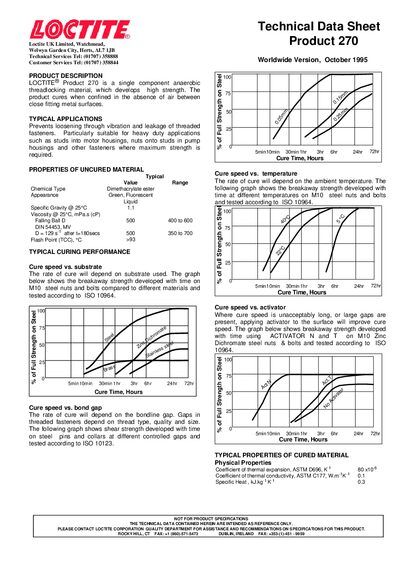
Technical data sheet for Loctite 270 anaerobic threadlocking material, detailing properties, curing performance, and usage instructions.
About this manual
Loctite 270 is a single‑component anaerobic threadlocking material that cures when confined between close‑fitting metal surfaces, providing high strength for heavy‑duty applications such as studs in motor housings and pump fasteners. The sheet describes typical applications, uncured material properties, and curing performance under various conditions.
Key specifications include specific gravity, viscosity, flash point, and mechanical strength values for both uncured and cured states. Environmental resistance, storage recommendations, and handling precautions are also provided, along with general usage directions and safety notes.
What's inside
- Product Description
- Typical Applications
- Properties of Uncured Material
- Typical Curing Performance
- Typical Properties of Cured Material
- Performance of Cured Material
- Typical Environmental Resistance
- General Information
- Directions for Use
- Storage
Specifications
| Specific Gravity @ 25 °C | 1.1 |
|---|
| Viscosity @ 25 °C (mPa·s) | 400–600 |
|---|
| Flash Point (TCC) °C | >93 |
|---|
| Breakaway Torque (typical) N·m | 26 |
|---|
| Prevail Torque (typical) N·m | 36 |
|---|
| Coefficient of Thermal Expansion (K‑180 ×10⁻⁶) | K‑180 ×10⁻⁶ |
|---|
| Thermal Conductivity (W·m⁻¹·K⁻¹) | 0.1 |
|---|
| Specific Heat (kJ·kg⁻¹·K⁻¹) | 0.3 |
|---|
Frequently asked questions
What is the typical breakaway torque for Loctite 270?
The typical breakaway torque is 26 N·m (range 16 to 36 N·m).
Is Loctite 270 suitable for use on plastics?
No, it is not normally recommended for use on plastics, especially thermoplastics that may stress‑crack.
What is the flash point of Loctite 270?
The flash point is greater than 93 °C.