Installation and startup guide for the Anderson Instrument ILM non‑contact conductivity sensor used in food and dairy processes.
About this manual
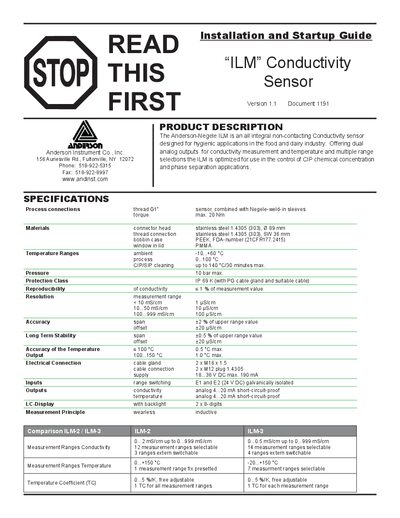
The ILM is an all‑integral, non‑contacting conductivity sensor designed for hygienic applications in the food and dairy industry. It provides dual analog outputs for conductivity and temperature, multiple range selections, and is suited for CIP chemical concentration and phase‑separation control.
This guide covers product description, specifications, mounting, wiring, programming, cleaning, maintenance, transportation, storage, repair return, disposal and dimensional drawing, giving step‑by‑step instructions for proper installation and startup of the sensor.
What's inside
- Product Description
- Specifications
- Mounting
- Wiring
- Programming Menu
- Cleaning and Maintenance
- Transportation/Storage
- Returning for Repair
- Disposal
- Dimensional Drawing
Specifications
| Process connection thread | G1" |
|---|
| Temperature range | -10 °C to +60 °C (ambient), 0 °C to 100 °C, up to 140 °C/30 min |
|---|
| Maximum pressure | 10 bar |
|---|
| Protection class | IP69K |
|---|
| Conductivity resolution | < 10 mS/cm |
|---|
Frequently asked questions
What torque should be applied when connecting the ILM sensor?
The connection must be torqued to 14.8 lb‑ft (20 Nm).
How can the measurement range be changed?
The range can be changed externally by applying a control voltage of +24 V DC to inputs E1 and/or E2.
What is the maximum temperature allowed for CIP cleaning?
The sensor can be cleaned at temperatures up to 140 °C for 30 minutes.