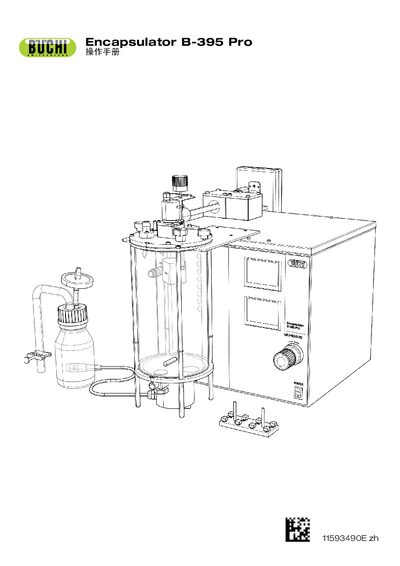
The Buchi B-395 Pro Encapsulator User Manual provides safety guidelines, setup, operation, maintenance, and troubleshooting instructions for laboratory use.
About this manual
This manual describes the safe operation and proper handling of the Buchi B-395 Pro Encapsulator, a semi‑automatic laboratory instrument for producing micro‑capsules. It is intended for trained laboratory personnel and includes safety precautions, technical specifications, and recommended procedures.
Key sections cover safety rules, technical parameters, installation and electrical connections, detailed operating steps, routine maintenance, fault detection, and disposal requirements. The document also lists standard accessories, optional nozzle kits, and recommended spare parts. This manual is written in Chinese.
What's inside
- About this Manual
- Safety
- Technical Parameters
- Installation
- Operation
- Maintenance and Service
- Fault Detection
- Shutdown, Storage, Transport and Disposal
- Declarations and Requirements
Specifications
| Power supply | 50–60 Hz, 100–240 V |
|---|
| Maximum working pressure | 1.5 bar |
|---|
| Reaction container capacity | 2 L |
|---|
| Nozzle size range | 0.08 mm – 1.00 mm |
|---|
Frequently asked questions
What personal protective equipment is required when operating the B‑395 Pro Encapsulator?
Operators must wear personal protective equipment such as safety glasses, protective clothing, and gloves.
What is the recommended voltage and frequency for the B‑395 Pro?
The instrument is designed for 100–240 V and 50–60 Hz mains supply.
What is the maximum working pressure of the pressure bottle used with the B‑395 Pro?
The pressure bottle can operate up to a maximum pressure of 1.5 bar.
What is the capacity of the standard reaction container?
The standard reaction container has a working capacity of 2 L.