
Key facts
- Manuals
- 1
- Languages
- EN
- Last added
- 2012-02-21
Featured SCHPTT manuals
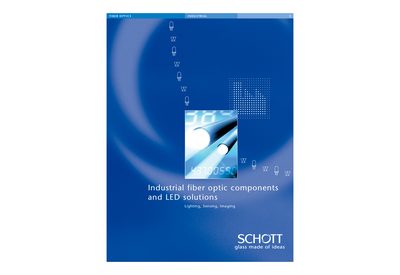
SCHOTT Industrial Fiber Optic Components and LED Solutions Product Leaflet
The leaflet introduces SCHOTT’s industrial fiber optic components and LED solutions, describing the company’s 40‑year history in high‑quality glass, fibers and optical systems for markets such as automotive, lighting, medical, industrial and defense. It explains the physical principles of LEDs and optical fibers, including core‑cladding structure, total internal reflection, and the impact of numerical aperture and spectral transmission.
Further sections detail the manufacturing and design of light guides, fiber types, mechanical protection, and various termination methods (epoxied, hot‑fused, grinding & polishing). The document also describes SCHOTT’s fiber‑drawing and cable‑extrusion technologies, lightline production methods, and example applications ranging from machine‑vision illumination to X‑ray imaging and semiconductor inspection.
Covers: Introduction · Physical principles of LEDs · Physical principles and properties of optical fibers · Manufacturing/Design of light guides · Fiber types · Mechanical protection
Latest SCHPTT manuals
SCHOTT Industrial Fiber Optic Components and LED Solutions Product Leaflet
Product Leaflet 13 pages · 4.7 MB · ENThis SCHOTT leaflet provides an overview of industrial fiber optic components and LED solutions, covering principles, designs, and applications.
Questions answered in SCHPTT manuals
What is the minimum cladding thickness required for visible‑range fibers?
The cladding must be at least 2 µm thick to ensure total internal reflection in the visible spectrum.
From: SCHOTT Industrial Fiber Optic Components and LED Solutions Product Leaflet
Up to what temperature can hot‑fused fiber ends operate reliably?
Hot‑fused ends can operate continuously at temperatures up to 350 °C.
From: SCHOTT Industrial Fiber Optic Components and LED Solutions Product Leaflet